

In just a few weeks, things have shifted more than in the past six months. CMHC tightened its MLI Select program on September 30, Quebec pushed back part of the new building code by one year, gas prices keep driving inflation up, and Quebec elected a minority government on October 5.
For anyone developing new multi-family rentals or joining a project as a partner, each of these factors directly affects how a project is financed. Here is our take, from the job site.
Key takeaways
- The Bank of Canada’s policy rate is at 2.25%, unchanged since October 2025, but fixed rates have risen along with 5-year bonds.
- Since September 30, 2026, new projects financed through MLI Select must meet stricter energy criteria.
- Some new building code standards (seismic, accessibility, EV charging) will apply on October 17, 2027, instead of in 2026.
- Inflation reached 3.0% in Canada in August, driven by gas prices and rents.
- Four-storey wood-frame and brick buildings fit current pro formas well, but it is not a one-size-fits-all formula. Concrete remains relevant when the location justifies it.
- Bringing the builder into the project from the design stage has become essential to get the most out of every project.
- The CCQ estimates the construction industry will need 17,000 new workers a year through 2030, while Quebec is preparing to lower its immigration levels.
Interest rates, stability that hides another reality
The Bank of Canada held its policy rate at 2.25% on September 2. That makes seven holds in a row.
But that rate is not what determines whether a rental project is viable. Long-term financing follows 5-year Government of Canada bonds, and those climbed throughout August. As a result, fixed rates went up while the headlines talked about stability.
That is why we track benchmark mortgage rates (Canada Mortgage Bonds) every month. They are what tell us whether a project holds up or not.
MLI Select, a higher energy bar since September 30
MLI Select remains the most advantageous financing option for new multi-family buildings. Loan-to-value ratios of up to 95%, amortization of up to 50 years and more flexible debt coverage requirements.
What changes for new construction are the energy efficiency criteria. Stricter insulation for walls, roofs and floors. An end to oil and propane heating in favour of solutions like heat pumps. Improved airtightness, mandatory depressurization tests and high-efficiency air exchangers.
In practical terms, the cost per door goes up. And these criteria must be built in from the design stage, not added at the end of the plans. A project that is poorly planned upfront can lose points, and with them its financing conditions. That is where a builder involved from the start makes all the difference.
Building code, a one-year reprieve for some standards
Quebec extended the building code’s transition period by one year. The new provisions on seismic protection, accessibility and electric vehicle charging stations will come into force on October 17, 2027, instead of October 2026.
The industry had sounded the alarm. According to an example presented by a general contractor, the new seismic standard alone would have added roughly $900,000 to a project planned in Quebec City.
Keep in mind, though, that a delay is not a cancellation. Some municipalities already apply the 2020 code. And any project starting after October 2027 needs to be planned under the new rules now.
Inflation and gas prices, cost pressure is back
Inflation held at 3.0% in Canada in August, and at 3.1% in Quebec. Gas prices rose 22.8% year over year, fuelled by the conflict in the Middle East.
On a job site, that adds up quickly. Material transportation, fuel for machinery, deliveries. Rising rents are also among the factors keeping inflation up, which confirms that rental demand remains strong.
A new government, what we are watching
The Parti Québécois won 59 of 127 seats and will form a minority government. Its housing priorities, the fate of existing programs and the application of the building code will take a few months to become clear.
A minority government has to work with the opposition, which can slow down some decisions. For developers and their partners, it adds another layer of short-term uncertainty. We will be following the first announcements closely.
Immigration and labour, a balance to strike
Construction in Quebec is already short on workers. The Commission de la construction du Québec (CCQ) estimates the industry will need to bring in about 17,000 people a year through 2030. It also points out that in several trades, the number of graduates is not enough to meet job site needs.
For its part, the new government has announced a new immigration plan within its first 100 days. The proposed direction is to cut temporary immigration in half and to bring permanent immigration down from about 45,000 to 35,000 people a year. The government says it wants to align these levels with Quebec’s capacity in terms of housing, French language integration and public services.
Some sectors would be spared, such as agriculture, manufacturing, certain regions and health care. Where construction will fit in this plan remains to be seen.
One more thing to keep in mind. For now, none of this is in effect. The immigration plan adopted before the election remains the official framework until the new one is tabled.
For a builder of rental housing, the issue cuts both ways. Fewer available workers can stretch timelines and drive up costs. Slower population growth can also change rental demand in some areas. Both effects deserve close monitoring, region by region.
On our end, we are focusing on what we can control. Recruiting and training locally, keeping our teams, and planning every project with realistic timelines from the design stage. We will be following the tabling of the immigration plan closely, and we hope the reality of job sites will be part of the conversation.
What these conditions change for private multi-family projects
Taken together, these factors call for more rigour than ever when putting together a new rental project. Higher fixed rates, rising construction costs, stricter energy requirements. The margin between a good and a not-so-good design decision is thinner than before.
That is why having a builder involved in the project from the start has become essential. When the people building it take part in the design, every choice is validated against real costs, construction timelines and financing requirements. That avoids bad surprises along the way and unlocks the project’s full potential, for the developer and for its partners.
How we are approaching this period
We do not see this context as a wall, but as a time when we need to be more precise than ever.
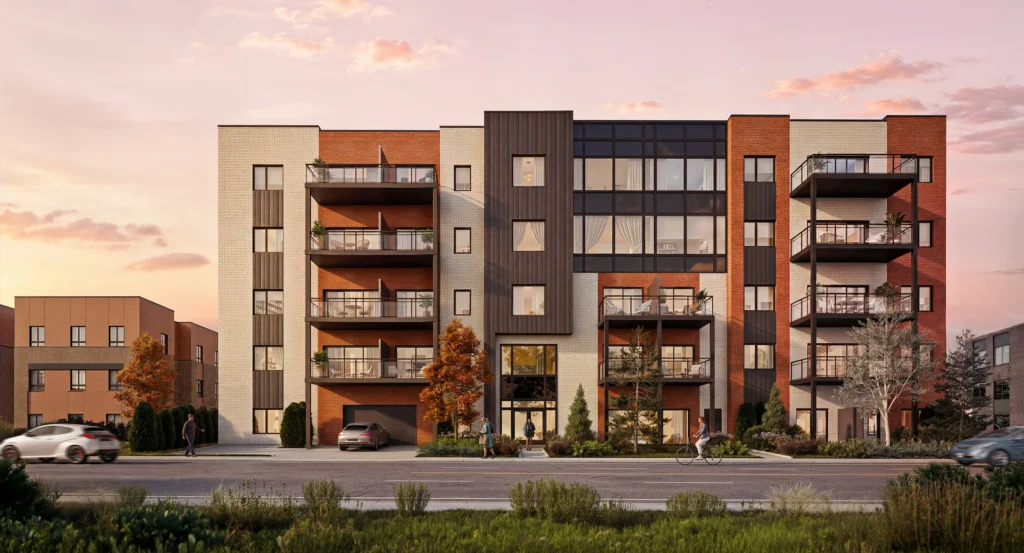
Today, we favour four-storey wood-frame and brick projects. In the current context, it is the approach that best fits our pro formas. According to our analyses, it saves 10 to 15% on total construction costs compared to concrete, with a shorter build and rents better aligned with the absorption rate in the areas where we build.
That does not make it a one-size-fits-all formula. Wood-frame and brick is the right answer for today’s market, not a permanent rule. Every site has its own equation, and when the location justifies it, we build in concrete. Just because a lot is zoned for 15 storeys does not mean you should build 15, and the reverse is also true.
That is where our integrated model, from construction to property management, really makes sense. Because the builder is part of the project from the start, every design decision is validated against real costs, the timeline and the reality of the rental market.
And when the market sends us a signal, we adjust. Quickly, and without ego.
In an upcoming article, we will look at how we choose between wood-frame and brick or concrete, and what that choice changes for a partner.
Frequently asked questions
Since September 30, 2026, new construction projects must meet higher energy efficiency criteria to earn points in the energy category. Existing buildings are not affected by this change.
Partly. The provisions on seismic protection, accessibility and EV charging stations will apply as of October 17, 2027. Some municipalities, however, already apply the 2020 code.
No one can guarantee it. Fixed rates depend on 5-year bonds, which are influenced by global inflation and oil prices, factors the Bank of Canada does not control.
Not necessarily. In the current context, for four-storey buildings, wood-frame and brick often fits the pro forma better. The choice still depends on several factors, such as absorption in the area, construction costs, project timelines and tenants’ ability to pay. When the location justifies it, concrete remains an option.
Because costs, energy standards and financing conditions leave less room for error. A builder involved from the design stage validates every choice against real costs and timelines, which helps get the most out of the project.
That remains to be seen. The new government is expected to table its plan within its first 100 days. Until then, the plan adopted before the election remains in effect.
Developing a project in Greater Montreal or on the South Shore? Let’s talk.